Deep Tissue Massage in Fort Collins.
Slow, targeted work for chronic neck, shoulder, and low-back tension. Built around what your body can actually receive — not whatever pressure the appointment book says you should get.
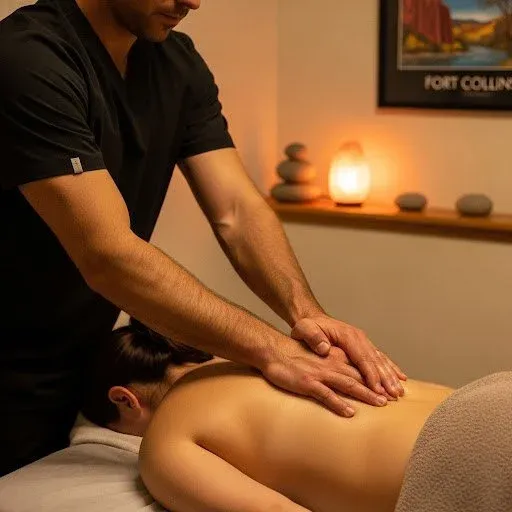
It's not just "harder Swedish."
The most common misconception: deep tissue means more pressure. It doesn't.
Deep tissue is about specific access - reaching the deeper muscle layers, the attachments, and the fascia in between - not about how hard I push. Real deep work is slower, more targeted, and often less aggressive than a strong Swedish session, because we're moving through tissue layer by layer instead of just leaning on what's on top.
I work the body as a three-dimensional system: agonist and antagonist muscle groups, the relationship between them, and the postural patterns that keep tension locked in. The goal isn't to leave you sore - the goal is to change something.
If any of these sound like you.
Deep tissue works best when there's a specific story behind the tension. Vague 'I want to relax' sessions are better served by Swedish or a foundational session.
Post-injury rehab
Once your PT or doctor clears you for massage, I work the soft tissue around a healing area - easing the compensation patterns and guarding when one part of the body protects another.
Desk-job neck & shoulders
Eight hours at a screen, locked traps, the tension headaches that start at the base of the skull. The most common booking I see - and one of the most satisfying to resolve.
Chronic low back
Tight hip flexors, a locked-up QL (the deep muscle along your lower spine), and the kind of low-back ache that lingers after rest. Often a combined deep-tissue and neuromuscular session.
Athletes & trail runners
For locked-up calves, tight IT bands, and glutes that won't fire after a hard training block. Often paired with sports stretching for healthy range of motion.
Slower than you'd think. Communicative throughout.
If you've had 'deep tissue' at a chain spa, this is going to feel different. Here's the structure most sessions follow.
Intake (5-10 min)
What's going on, when it started, what you've tried. Quick postural assessment if it's helpful.
Warming the tissue
Slower, rhythmic Swedish strokes to warm the area before depth. Skipping this is how chains hurt people.
Targeted work
Specific access to the layers we identified during intake. Communicating about pressure throughout - you're a participant, not a patient.
Close it out
Lighter strokes across the whole area to tie the work together, plus any stretches that'll help between sessions.
What people ask before booking.
Will I be sore after?
Sometimes a little - usually not. If a session leaves you really sore, the work was too aggressive. I aim for the pressure where your body can release without bracing. Tell me if it's too much, always.
How often should I come?
Depends on what we're working on. For a chronic pattern: every 2-3 weeks until we've actually moved it, then every 4-6 weeks for maintenance. For an acute issue, weekly for a few weeks. I'll always say honestly when you don't need to come back as often.
Can deep tissue help with headaches?
Often yes - especially tension headaches that start at the base of the skull or wrap around the temples. Trigger-point release in the upper traps and suboccipitals (the small muscles at the top of your neck) is one of the most effective non-medication interventions I know of.
Is deep tissue safe if I'm on medication or have a health condition?
Usually, but tell me everything during intake. Blood thinners, recent surgery, active inflammation, pregnancy - all of these change how I work. If something's a contraindication, I'll tell you, and we'll find a different approach that's safe.
Will you actually do deep tissue, or is this a relaxation session in disguise?
Yes, this is real deep tissue. The technique is slow and specific because that's how depth actually works - not because I'm holding back.
Two modalities that work well alongside.
'Integrative' means most sessions blend - these two are the most common partners for deep tissue work.
Book deep tissue work.
If something specific is going on — tell me when you book. We'll build the session around it.